

Understanding Manufacturing Staffing Regulatory Challenges Ontario 2026
Ontario’s manufacturing sector grapples with a complex web of regulations that evolve quickly. In 2026, these rules demand more from employers, especially those relying on temporary staffing for skilled trades. Key changes include stricter pay transparency Ontario requirements and updates to the Employment Standards Act (ESA). Manufacturers must adapt to avoid penalties, which can reach $1,000 per violation under the ESA.
Consider a mid-sized auto parts plant in Windsor. They hired 50 temporary welders last year but faced fines for incomplete record-keeping. This highlights why proactive compliance matters.
- Pay transparency Ontario: Post salary ranges in all job ads to promote fairness.
- AI disclosure hiring: Reveal if algorithms screen candidates, per new provincial guidelines.
- ESA changes 2026: Extended notice periods for temp workers exceeding 90 days.
These shifts push companies toward better hiring transparency and workforce agility.
ESA Changes 2026 and Their Impact on High-Volume Temporary Hiring in Manufacturing

The ESA changes 2026 introduce rules that hit manufacturing hard, where temp hiring spikes during production ramps. For instance, manufacturers now provide equal pay for equal work to temps after 30 days, up from previous thresholds.
This applies directly to high-volume scenarios, like assembly lines needing quick fills for machinists or technicians. Factories in Toronto’s industrial zones report 20% higher compliance costs without proper planning.
Here’s a quick breakdown:
- Review all temp contracts quarterly.
- Train HR on updated vacation pay calculations, now at 4% for temps.
- Audit payroll systems for automatic equal pay triggers.
One Ontario manufacturer avoided $50,000 in fines by partnering with a staffing expert for audits. If you’re facing similar issues, reach out to our team at SkilledReady for tailored support.
Temporary Staffing Agency Licensing Requirements and Compliance in Ontario
Ontario requires all temp agencies to hold a license under the Employment Standards Act. This ensures ethical practices, but many overlook the annual renewal fees of $750 and mandatory bonding of $25,000.
For manufacturing, compliance means verifying agency licenses before engaging, especially for roles like forklift operators or quality inspectors. Non-compliance risks joint liability for unpaid wages.
Key steps for manufacturers:
- Check the Ministry of Labour’s online registry for agency status.
- Demand proof of workers’ compensation coverage.
- Include compliance clauses in all contracts.
SkilledReady, as a leading provider of skilled temporary workers, handles these details seamlessly with our state-of-the-art software that supplies the right worker faster.
Integrating Occupational Health and Safety Act (OHSA) with Staffing Practices
The Occupational Health and Safety Act (OHSA) mandates safe environments, but integrating it with temp staffing adds layers. Manufacturers must train temps on site-specific hazards within their first shift, per OHSA Section 25.
In practice, this means geo-fencing technology to track worker locations precisely, ensuring they’re not in restricted zones. A Hamilton steel plant reduced incidents by 15% using mobile apps for clock-in/out and safety checklists.
Essential integrations:
- Joint health and safety committees including temp reps.
- Record-keeping obligations for all incidents, retained for two years.
- Regular audits aligning with skilled labor regulations.
These steps foster positive, inclusive work environments, aligning with core values like integrity and excellence.
If integrating OHSA feels overwhelming, consider consulting experts who specialize in this area.
Immigration and Foreign Worker Regulations for Addressing Manufacturing Talent Shortages
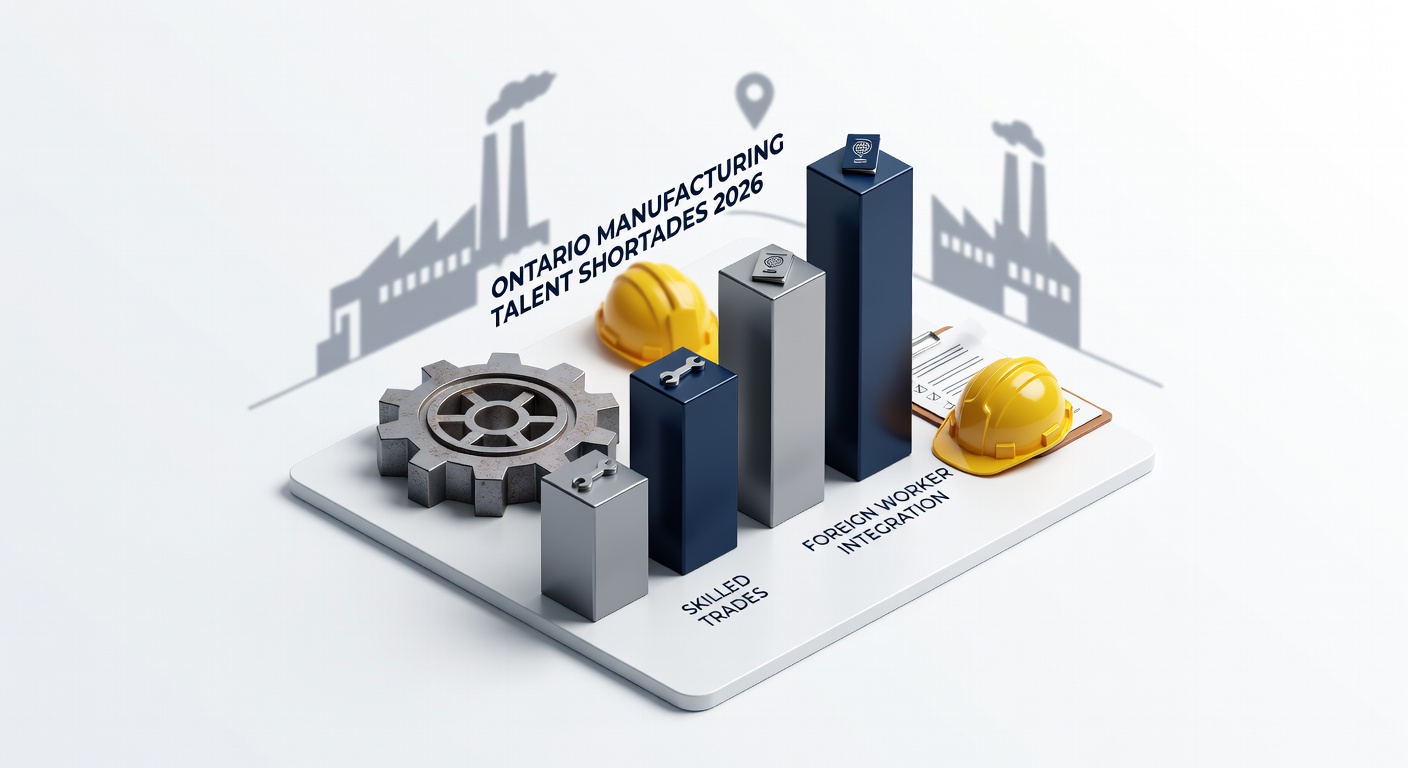
Ontario’s talent shortage manufacturing persists, with 25,000 unfilled skilled positions projected for 2026. Immigration rules offer solutions, but the Canadian experience prohibition bans preferring candidates with local work history.
Manufacturers can tap the Temporary Foreign Worker Program (TFWP), which requires Labour Market Impact Assessments (LMIAs) proving no locals are available. Processing times average 10 weeks, so plan ahead.
Real-world example: A Kitchener electronics firm hired 20 foreign machinists via TFWP, boosting output by 30%. They navigated regs by using data-driven talent mapping.
Strategies to implement:
- Partner with licensed immigration consultants.
- Use job posting requirements Ontario to advertise widely before LMIA applications.
- Track foreign worker visas with dedicated software.
This approach maximizes workforce agility without violating rules.
Case Studies: Real-World Navigation of Regulatory Challenges in Ontario Manufacturing

Let’s look at practical examples. A Brampton packaging plant faced manufacturing staffing regulatory challenges Ontario 2026 during a expansion. They struggled with ESA equal pay rules for 100 temps.
By adopting customizable HR strategies and our mobile app for time tracking, they cut compliance errors by 40%. Client satisfaction hit 4.8/5 in reviews.
Another case: An Ottawa manufacturer dealt with OHSA violations from poor temp training. Integrating geo-fencing and expert HR consulting resolved issues, avoiding $10,000 fines.
These stories show how trusted partners like SkilledReady, with hundreds of companies relying on us for temp placements, deliver results.
Forward-Looking Strategies for Temporary Staffing in Skilled Trades
To thrive amid 2026 changes, focus on proactive measures. Use talent acquisition with data-driven insights to forecast needs.
Build employer branding that emphasizes inclusivity, drawing from industry best practices. Recruitment process outsourcing can handle volume without internal strain.
Quick tips:
- Invest in talent mapping for six-month projections.
- Align strategies with business goals for maximum productivity.
- Leverage mobile tools for accurate tracking.
Companies that adapt see 25% better retention in temp roles. For personalized advice on these strategies, connect with SkilledReady’s dedicated team today.
Overcoming Common Pitfalls in Record-Keeping Obligations
Record-keeping obligations under Ontario law require retaining employee files for three years post-employment. For manufacturers, this includes temp worker hours, pay stubs, and safety training logs.
Common pitfalls include digital storage failures, leading to data loss. Use secure, cloud-based systems to comply.
Steps to avoid issues
- Implement automated backups weekly.
- Train staff on privacy laws like PIPEDA.
- Conduct annual compliance audits.
A Mississauga factory sidestepped penalties by outsourcing to experts in HR solutions.
With these insights, you’re better equipped to handle manufacturing staffing regulatory challenges Ontario 2026.
Frequently Asked Questions
What are the key manufacturing staffing regulatory challenges Ontario 2026?
Key challenges include ESA changes 2026 requiring equal pay for temps, pay transparency in job postings, and AI disclosure in hiring processes. Manufacturers must also navigate OHSA integrations and immigration rules to address talent shortages.
How do ESA changes 2026 affect temporary hiring in manufacturing?
ESA changes mandate equal pay after 30 days, extended notice for temps, and stricter vacation pay. High-volume manufacturing hiring needs quarterly contract reviews and payroll audits to stay compliant.
What licensing do temporary staffing agencies need in Ontario?
Agencies require an ESA license with annual $750 renewals and $25,000 bonding. Manufacturers should verify this to avoid joint liability for issues like unpaid wages.
How can manufacturers integrate OHSA with staffing practices?
Integrate by training temps on first shift, using geo-fencing for location tracking, and including them in safety committees. This reduces incidents and meets record-keeping obligations.
What immigration regulations help with manufacturing talent shortages?
Use the Temporary Foreign Worker Program with LMIAs, avoiding Canadian experience preferences. Plan for 10-week processing to fill skilled roles legally.
Are there case studies on navigating Ontario manufacturing regulations?
Yes, a Brampton plant reduced compliance errors by 40% with HR tech, and an Ottawa firm avoided fines through expert consulting and safety integrations.
What strategies address workforce agility in 2026 regulations?
Focus on data-driven talent mapping, mobile time tracking, and recruitment outsourcing. These align with business goals for better productivity and compliance.